
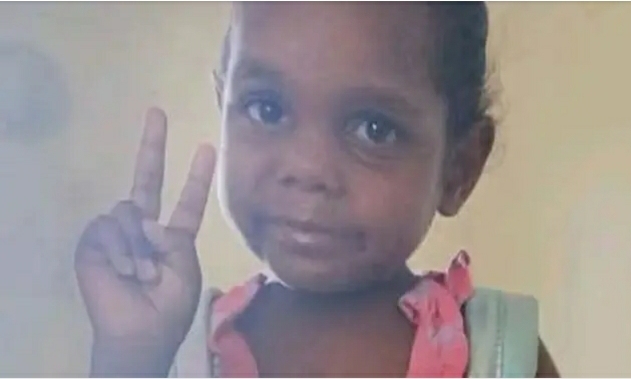
ALICE SPRINGS, NT – April 30, 2026 – The red dust of Central Australia has turned to mud with tears. What began as a frantic, community-wide search for a missing five-year-old girl has ended in the deepest sorrow imaginable. Kumanjayi Little Baby, a child whose name is now spoken with the weight of collective grief, has been found deceased, according to authorities in the Northern Territory.
Before midday on Thursday, police and search crews located a body believed to be that of the young girl, bringing a devastating close to days that had been filled with hope, prayer, and relentless effort. For the family, for the town of Alice Springs, and for Indigenous communities across the country, the loss is nothing short of catastrophic.
In accordance with Indigenous cultural customs, her full name—Kumanjayi Little Baby—is now used openly as a mark of reverence and mourning. Traditionally, the names of the deceased are spoken with great care and respect, often accompanied by specific protocols. Her community has honored those traditions while also allowing the wider public to grieve alongside them.
This is the story of a precious young life, an agonizing search, and a tragedy that has shaken the Northern Territory to its core.
—
Part 1: The Disappearance – When a Child Vanished Without a Trace
Kumanjayi Little Baby was last seen on [insert date prior to discovery, e.g., Monday evening] in a residential area of Alice Springs, a remote town known for its stunning desert landscapes, rich Indigenous heritage, and, in recent years, social struggles that have left many families vulnerable. According to initial police reports, the five-year-old was playing near her home when she seemingly vanished.
A missing person alert was issued within hours. Family members, neighbors, and local volunteers began searching yards, creeks, and scrubland. By the following morning, the Northern Territory Police had deployed search-and-rescue teams, including officers on foot, in vehicles, and—when conditions allowed—in the air. Volunteers from nearby cattle stations and Aboriginal communities joined the effort, covering ground that stretched for kilometers around Alice Springs.
For nearly two days, the only updates from authorities were cautious: “We remain hopeful.” “We are following several leads.” “The family is cooperating fully.” But inside the tight-knit community, hope had already begun to curdle into fear. Children do not simply vanish in the desert without consequences.
—
Part 2: The Discovery – Before Midday, a Grim Finding
At approximately 11:30 a.m. local time on Thursday, April 30, 2026, search crews made a heartbreaking discovery. A body matching the description of Kumanjayi Little Baby was found in a location that police have not yet publicly disclosed, citing both the ongoing investigation and respect for Indigenous cultural protocols regarding the handling of deceased individuals.
A spokesperson for the Northern Territory Police confirmed the finding in a brief, somber press conference:
“It is with profound sadness that we confirm that a body believed to be that of the missing five-year-old girl, Kumanjayi Little Baby, has been located. Formal identification is pending, but there is no reason at this stage to believe it is anyone else. Our thoughts are with her family, her mother, her brother, and all who loved her.”
The spokesperson declined to comment on the cause of death, whether foul play is suspected, or whether any person has been taken into custody. What is known is that the discovery was made before midday, as stated in earlier community notices, and that the area was immediately cordoned off for forensic examination.
For the volunteers who found her, for the police who processed the scene, and for the family who waited with unbearable hope, that midday hour will forever mark the moment when possibility died.
—
Part 3: The Family – A Mother and a Brother Grieve
No words can adequately capture the grief of losing a child. But Kumanjayi Little Baby’s mother and brother have attempted to give voice to their pain, releasing a statement through the Northern Territory’s Department of Children and Families. The statement, brief and raw, read in part:
“Our daughter. Our sister. Our little baby. She was only five years old. She had so much life in her. She loved to dance, to chase the dogs, to ask questions about everything. Now she is gone. We don’t know why. Our hearts are shattered into pieces that will never fit back together.”
The statement went on to thank the search volunteers, the police, and the wider Alice Springs community for their “endless effort and love.” It also requested privacy as the family prepares for a traditional sorry business—a period of mourning, ceremony, and remembrance that varies among Indigenous groups but universally centers on respect for the deceased and support for the bereaved.
The brother of Kumanjayi Little Baby, whose name has not been released due to his age and cultural protocols, is said to be “inconsolable.” According to a family friend who spoke on condition of anonymity, the two siblings were exceptionally close. “He would walk her to the bus stop every morning, even though it was only three houses away,” the friend said. “He was her protector. And now he doesn’t understand how he failed.”
—
Part 4: Indigenous Cultural Customs – Speaking Her Name With Reverence
The public use of the name “Kumanjayi Little Baby” is not a violation of tradition but rather an adherence to a specific cultural practice. In many Indigenous communities in Central Australia, the name of the deceased is spoken openly only after a period of mourning, and often with a qualifier of deep respect. In this case, the family has chosen to release her full name as a way of honoring her life and ensuring that she is not forgotten.
It is important to understand that “Kumanjayi” is not merely a first name but a designation carrying cultural weight—often associated with a specific skin name, dreamtime connection, or family lineage. “Little Baby” reflects the endearing way she was known within her immediate circle. To speak her name now is to acknowledge that she lived, she mattered, and her loss is shared.
Aunty Margaret Williams, a senior Arrernte elder and community advocate, explained the significance:
“When a little one passes, we don’t hide their name in shame. We say it so that their spirit knows it is still loved. Kumanjayi Little Baby. Say it gently. Say it with sorrow. But say it. Because she deserves to be remembered.”
This cultural context is vital for non-Indigenous readers to understand. The naming is not sensationalism; it is an act of mourning sanctioned by her family and community.
—
Part 5: Alice Springs – A Town in Crisis, A Community United
The tragedy of Kumanjayi Little Baby does not exist in a vacuum. Alice Springs, a town of approximately 25,000 people, has been described by some as “a town on the edge.” In recent years, it has grappled with rising crime rates, alcohol-related harm, overcrowded housing, and a youth crisis that has seen too many children fall through cracks in the system.
Yet for all its challenges, Alice Springs is also a place of extraordinary community spirit. When Kumanjayi went missing, hundreds dropped everything to search. Local businesses donated food and water. The Royal Flying Doctor Service offered logistical support. Social media was flooded with missing posters in English, Arrernte, and Warlpiri.
That same spirit now turns to grief. A makeshift memorial has appeared outside the Alice Springs Town Council offices, featuring stuffed animals, handwritten notes, and flowers—some wild, some plastic, all heartfelt. One note, written in a child’s shaky handwriting, reads: “Dear Kumanjayi, I didn’t know you but I am crying. I hope heaven has swings.”
Local schools have brought in trauma counselors. The Northern Territory government has pledged additional mental health resources for the town. And Indigenous leaders have called for a full, transparent investigation into the circumstances surrounding her death, while also urging calm and unity.
—
Part 6: The Investigation – What Police Are Doing Now
As of Thursday evening, the Northern Territory Police have not released a cause of death. A forensic post-mortem examination is expected to take place in Darwin within the next 48 hours. Depending on findings, the investigation could take several paths:
1. Accidental death – If Kumanjayi wandered into a dangerous area (e.g., a drainage ditch, an abandoned property, or extreme heat exposure) with no foul play involved.
2. Neglect-related death – If authorities determine that her caregivers failed to provide adequate supervision, potentially leading to criminal charges.
3. Homicide – If evidence points to an intentional act by another person, which would trigger a major crime unit investigation.
No arrests have been made. No suspects have been named. Police have not confirmed whether any person of interest has been interviewed.
What is known is that the location where her body was found is being treated as a crime scene until proven otherwise. Detectives are canvassing the area, reviewing CCTV footage from nearby homes and businesses (where available), and speaking with anyone who may have seen Kumanjayi in the hours before her disappearance.
Police have also appealed to the public: “If you have any information—no matter how small or seemingly insignificant—please come forward. This is a five-year-old child. She deserves answers.”
A dedicated hotline has been established: 131 444 (NT Police Assistance Line), with reference number NT-2026-0430-KLB.
—
Part 7: Fragility of Life – A Child Who Deserved a Future
It is a cliché born of truth: the death of a child strikes harder than almost any other loss. It defies the natural order. It robs not only a present but a future—birthdays, first days of school, graduations, weddings, grandchildren. All of that potential, extinguished before it could even begin to bloom.
Those who knew Kumanjayi Little Baby describe her as a child of remarkable warmth. A family friend, Tanya Ross, told reporters:
“She would give you a hug like you were the most important person in the world. And to her, you were. She didn’t care about skin color or money or any of that grown-up nonsense. She just loved. That’s all. She just loved.”
In her short five years, Kumanjayi had already learned to count to twenty in English and to ten in Arrernte. She knew how to find bush tomatoes with her grandmother. She was afraid of the dark but brave about spiders. These small, precious details are what her family will cling to in the months and years ahead.
The tragedy now is not only that she died, but that so many children like her live in circumstances where danger lurks too close—where a moment of inattention, a broken fence, a distracted driver, or a person with ill intent can end everything.
—
Part 8: Support and Mourning – What Comes Next
In the immediate aftermath, Kumanjayi Little Baby’s family will observe sorry business—a period that can last several days to a week, during which community members gather to share stories, cry together, sing, and perform ceremonies that help guide the child’s spirit back to country. Non-Indigenous friends and supporters are often welcome to pay respects but are advised to follow the lead of family elders.
A public memorial is being planned for early next week at the Alice Springs Civic Centre, with details to be announced by the Tangentyere Council. A GoFundMe campaign has been launched to assist with funeral expenses and to support the family in their time of need. As of this writing, over $15,000 has been raised in less than six hours.
The Northern Territory Chief Minister issued a statement earlier today:
“The loss of any child is a tragedy beyond words. But the loss of Kumanjayi Little Baby has broken something in all of us. We owe her family answers, support, and justice—whatever form that justice may take. My government will provide every resource necessary to ensure this never happens again. Though we know no policy can bring back a child.”
—
Conclusion: Rest Peacefully, Kumanjayi Little Baby
The sun sets over Alice Springs tonight as it always has—red, vast, indifferent. But the people beneath that sunset are not indifferent. They are grieving. They are angry. They are holding their own children a little tighter. They are asking hard questions about safety, about support for families, about why a five-year-old girl is no longer here.
Her family has asked, through their grief, that she be remembered not for the tragedy but for the love she gave. And so we remember: a little girl who liked to dance, who chased dogs, who asked endless questions. A little girl whose name is now a prayer on the lips of a wounded town.
Kumanjayi Little Baby. Five years old. Never forgotten.
—
How to Help
· Information to NT Police: Call 131 444, reference NT-2026-0430-KLB
· Donations: GoFundMe (verified by Tangentyere Council) – search “Justice and Mourning for Kumanjayi”
· Crisis support: Lifeline Australia 13 11 14; 13YARN (for Indigenous support) 13 92 76
Leave a Reply